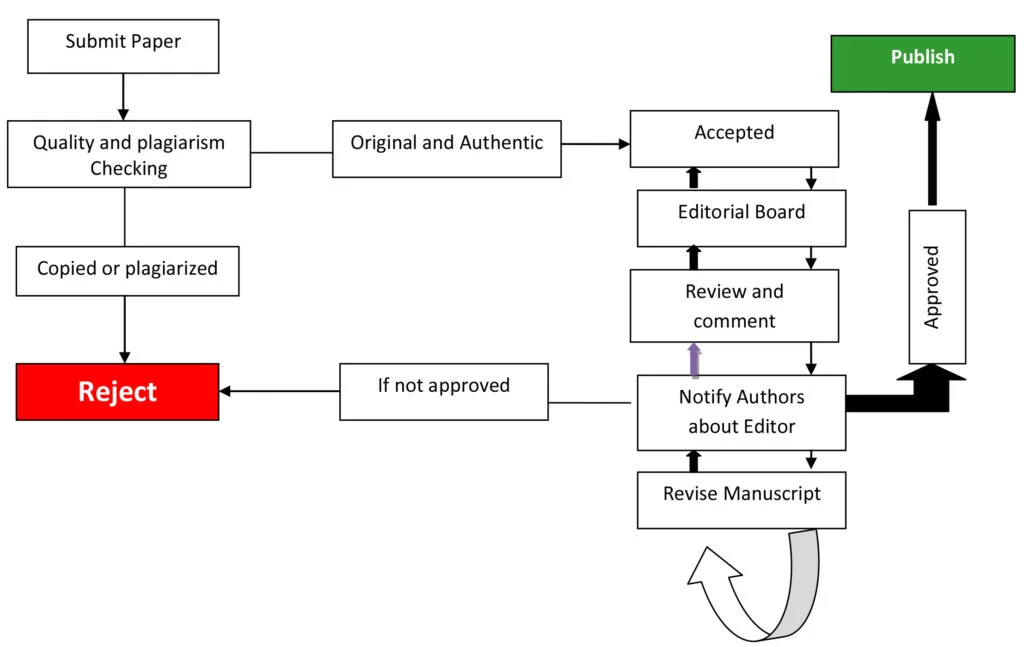
PEER REVIEW POLICY

NAS Publisher is committed to maintaining the quality, integrity, and credibility of scholarly publishing. All submitted manuscripts undergo an editorial assessment and, where appropriate, peer review before a final publication decision is made.

The peer review process is conducted fairly, confidentially, and independently. Editorial decisions are based on the scholarly quality, originality, relevance, methodological soundness, and ethical standards of the submitted work.

1. Purpose of Peer Review

Peer review helps editors assess the quality and suitability of submitted manuscripts for publication. The process aims to evaluate:

  • Originality and significance of the research
  • Relevance to the journal’s scope
  • Scientific or scholarly quality
  • Research methodology
  • Accuracy and validity of findings
  • Clarity of presentation
  • Ethical compliance
  • Appropriate use of references and supporting evidence

Peer review also provides constructive feedback to help authors improve their manuscripts.

2. Initial Editorial Assessment

All submitted manuscripts are initially assessed by the Editor-in-Chief, Managing Editor, or an authorized editorial representative.

The initial assessment may consider:

  • Suitability for the journal’s scope
  • Compliance with submission and manuscript preparation requirements
  • Completeness of the submission
  • Basic scholarly quality
  • Potential ethical concerns
  • Similarity or plagiarism concerns

Manuscripts that do not meet the journal’s basic requirements may be returned to the authors for correction or declined without external peer review.

3. Peer Review Model

NAS Publisher journals may use a double-anonymous peer review model, in which the identities of authors and reviewers are not disclosed to each other during the review process.

The specific peer review model used by each journal will be clearly stated on the individual journal website.

Where another review model is used, the journal will clearly explain the process to authors, reviewers, and readers.

4. Selection of Reviewers

Reviewers are selected based on their relevant expertise, academic qualifications, research experience, and ability to provide an objective assessment.

Editors should avoid selecting reviewers with conflicts of interest.

Reviewers are expected to disclose any actual or potential conflicts of interest before accepting a review assignment. If a conflict exists, the reviewer should decline the invitation or inform the editor.

NAS Publisher may invite external reviewers, editorial board members, or other qualified subject specialists.

5. Reviewer Responsibilities

Reviewers are expected to:

  • Review manuscripts objectively and professionally.
  • Evaluate the manuscript based on scholarly merit.
  • Provide clear and constructive comments.
  • Maintain the confidentiality of the manuscript and review process.
  • Declare potential conflicts of interest.
  • Avoid using unpublished information obtained through peer review for personal or professional advantage.
  • Complete reviews within the agreed review period.

Reviewers should not contact authors directly regarding a manuscript under review unless specifically authorized by the journal.

6. Confidentiality

Manuscripts submitted for peer review are confidential documents.

Editors and reviewers must not disclose information about a submitted manuscript to unauthorized individuals.

Reviewers must not share, reproduce, distribute, or use unpublished manuscript content without permission from the editorial office.

Reviewer identities will be handled according to the peer review model used by the relevant journal.

7. Editorial Decisions

Editorial decisions are made by the Editor-in-Chief or an authorized editor based on the manuscript, reviewer reports, editorial assessment, and other relevant scholarly and ethical considerations.

Possible editorial decisions may include:

  • Accept
  • Minor Revision
  • Major Revision
  • Reject

Editors may request additional reviews where reviewer reports are incomplete, conflicting, or insufficient for an informed decision.

The final decision rests with the responsible editor.

Editorial decisions must be independent of commercial considerations, including Article Processing Charges (APCs) or an author’s ability or willingness to pay publication fees.

8. Revision Process

Authors may be asked to revise their manuscript in response to reviewer and editorial comments.

Authors should:

  • Address reviewer comments carefully and respectfully.
  • Revise the manuscript where appropriate.
  • Provide a clear response to the comments when requested.
  • Explain and justify any comments that cannot be addressed.

Revised manuscripts may be returned to the original reviewers or assessed by the editor.

Submission of a revised manuscript does not guarantee acceptance.

9. Conflicts of Interest

Editors, reviewers, and authors must disclose relevant conflicts of interest.

Editors should not handle manuscripts where they have a significant conflict of interest, including manuscripts involving:

  • Their own work
  • Close professional collaborators
  • Family members
  • Situations that may reasonably affect impartial decision-making

Alternative editorial arrangements should be made when a conflict exists.

10. Ethical Concerns

Potential concerns relating to research ethics, authorship, plagiarism, duplicate publication, data integrity, image manipulation, or other publication ethics issues may be investigated during peer review or after publication.

Where concerns arise, NAS Publisher may:

  • Request clarification or additional information from the authors.
  • Seek expert or institutional advice where appropriate.
  • Suspend the review or publication process.
  • Reject the manuscript.
  • Take other appropriate editorial action.

Serious concerns will be handled in accordance with the publisher’s Publication Ethics Policy.

11. Appeals and Complaints

Authors may submit an appeal or complaint regarding an editorial decision or the handling of a manuscript.

Appeals should provide clear reasons and supporting information.

Appeals will be reviewed by the Editor-in-Chief or another appropriate editorial authority who was not directly involved in the original decision, where possible.

Submission of an appeal does not guarantee that the original decision will be changed.

12. Peer Review Timelines

NAS Publisher aims to conduct peer review efficiently while maintaining the quality and integrity of the review process.

Review timelines may vary depending on:

  • The availability of qualified reviewers
  • The complexity and subject area of the manuscript
  • The number of revision rounds required
  • Editorial workload

The journal should not guarantee acceptance or an unrealistically fixed peer review period.

13. Post-Publication Review and Corrections

NAS Publisher is committed to maintaining the integrity of the scholarly record.

Concerns identified after publication may result in appropriate editorial action, including:

  • Corrections
  • Expressions of concern
  • Retractions
  • Other necessary post-publication updates

Such actions will be handled according to the publisher’s policies and applicable publication ethics standards.

14. Editorial Independence

Editors are responsible for making editorial decisions based on scholarly merit and the journal’s editorial standards.

Editorial decisions must not be influenced by:

  • Article Processing Charges
  • Advertising
  • Commercial interests
  • Personal relationships
  • Institutional pressure

NAS Publisher supports editorial independence and fair decision-making throughout the peer review process.

15. Transparency

NAS Publisher is committed to providing clear information about its peer review process.

Each journal should clearly state:

  • The peer review model used
  • The editorial process
  • Reviewer expectations
  • Editorial decision-making procedures
  • Procedures for appeals and complaints

Scroll to Top